AI4DRR: Artificial Intelligence for Disaster Risk Reduction
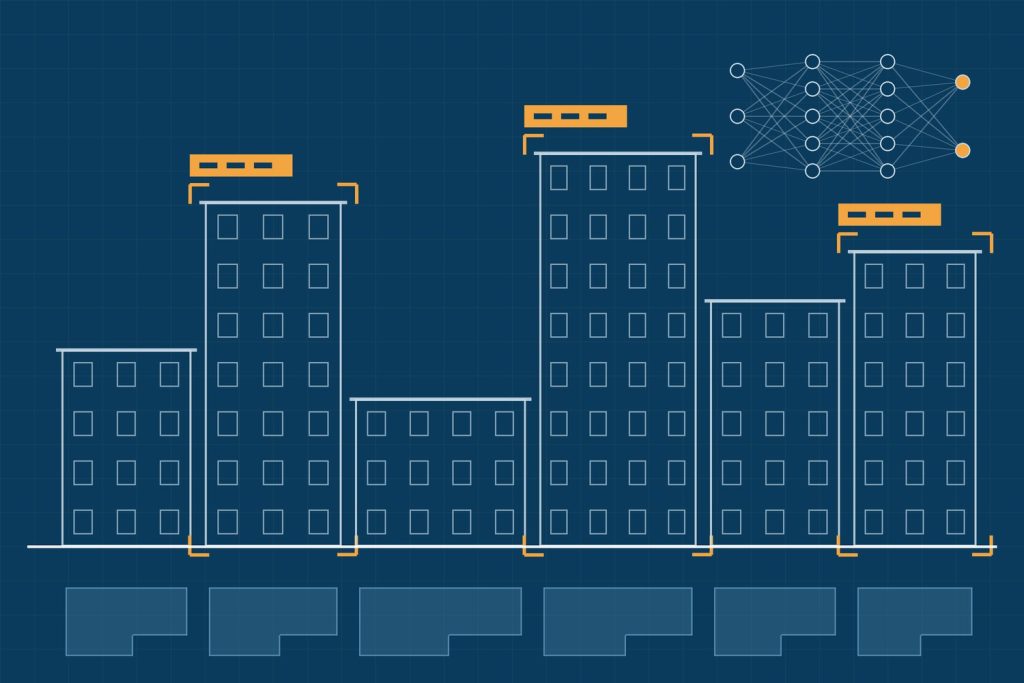
AI4DRR — Artificial Intelligence for Disaster Risk Reduction was an exploratory FCT project at Universidade Fernando Pessoa (UFP). It built a prototype platform that uses artificial intelligence to create, automatically, the exposure models that risk assessment needs: a digital description of each building and its structural characteristics.
How it works
- Footprint — each building is identified in OpenStreetMap;
- Images — the Google Street View API collects photographs of each building from different angles;
- Structure — a deep learning model estimates the most likely structural attributes from those images, trained on a new database of photographs of buildings with known attributes;
- Digital asset — an artificial neural network combines the footprint, the estimated attributes and the building height from satellite imagery into a digital representation of each asset.
The platform was tested in a parish of Lisbon, where ground-truth data made it possible to measure its accuracy. The approach can classify the built environment of large regions, and so support risk assessment for many kinds of hazard. The project had the support of the Humanitarian OpenStreetMap Team and the SimCenter AI group in California.
Team
The project was coordinated by Prof. Vítor Silva. The research team:
- Prof. Vítor Silva, UFP — principal investigator
- Prof. Feliz Gouveia, UFP
- Prof. Rui Silva Moreira, UFP
- Prof. José Torres, UFP
- Prof. Luís Paulo Reis, LIACC / University of Porto
- Jorge Lopes, MSc student, UFP
- Muhammad Umar, MSc student, UFP
Collaborators: Romain Sousa, Maria João Guerreiro, Ivo Pereira, and BSc students Nuno Moutinho and Daniel Moreira.
Outputs
- Feliz Gouveia, Vítor Silva, Jorge Lopes, Rui S. Moreira, José M. Torres, Maria Simas Guerreiro. Automated identification of building features with deep learning for risk analysis. Discover Applied Sciences 6(9), 2024. doi.org/10.1007/s42452-024-06070-2
- Vítor Silva, Romain Sousa, Feliz Gouveia, Jorge Lopes, Maria João Guerreiro. A Building Imagery Database for the Calibration of Machine Learning Algorithms. Earthquake Spectra, 2024. doi.org/10.1177/87552930241229103
- Jorge Lopes, Feliz Gouveia, Vítor Silva, Rui Moreira, José Torres, Maria Guerreiro, Luís Paulo Reis. Using Deep Learning for Building Stock Classification in Seismic Risk Analysis. EPIA 2023, Faial, Azores, 5–8 September 2023. doi.org/10.1007/978-3-031-49011-8_41
- Vítor Silva, Jorge Lopes, Feliz Gouveia, Romain Sousa. Exposure Modelling through Machine Learning for Multi-Hazard Risk Assessment. ICASP14, Dublin, Ireland, 9–13 July 2023. Paper (PDF)
- Building façade dataset: GitHub and Zenodo.
- Presentations at the UFP research seminar (video), Sibiu Innovation Days 2023, the 2022 Portuguese Conference on Structural Engineering and Seismology (SÍSMICA 2022), and the UFP Science & Technology Week 2023.
Funding
Exploratory research project EXPL/ECI-EGC/1555/2021, funded by national funds through FCT — Fundação para a Ciência e a Tecnologia, I.P. It ran from November 2021 to November 2023. DOI: 10.54499/EXPL/ECI-EGC/1555/2021.